


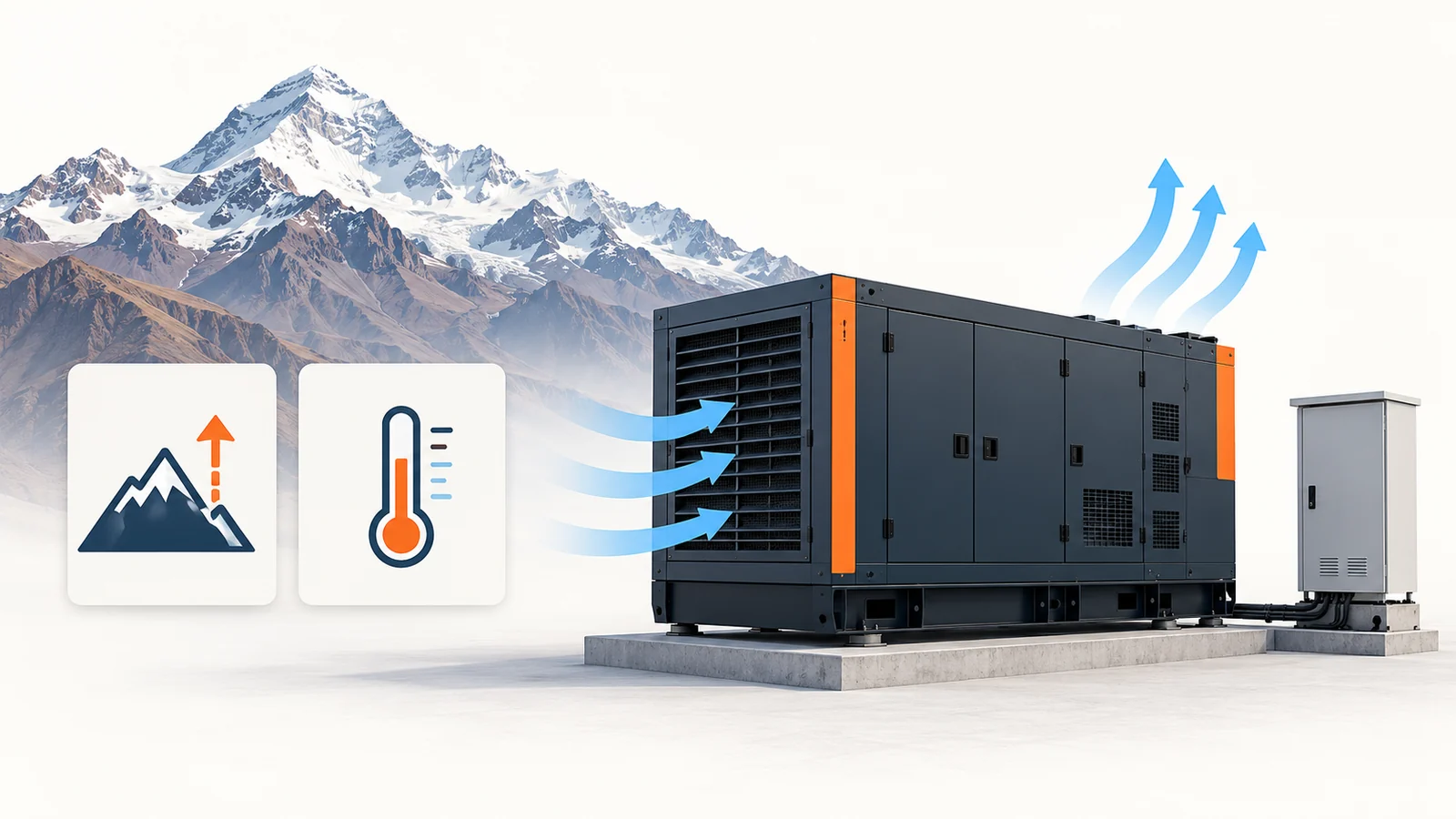



Assess generator altitude derating in Chile
An industrial generator for a site in Chile must suit the project’s conditions. State the site elevation in metres and the temperature, in degrees Celsius, of air entering the cooling system. Request the package’s available output under those conditions and the operating duty to which that output applies.
Generators supply their loads within the equipment’s limits. An output declared for different conditions does not establish that the package meets the project’s demand. First define the required power, then compare the supplier’s selection with that evidence.
Engine, alternator and cooling air
The internal combustion engine delivers mechanical energy to the alternator, which converts it into electrical energy. The alternator’s magnetic field plays a part in producing electric current. That function does not remove the equipment’s cooling limits when air density changes.
Section 6.3.8 of the Cummins T-030 manual explains that altitude and air temperature affect the engine, alternator and cooling system. The manufacturer must assess those effects for the proposed design. Distinguish engine mechanical output from the electrical output the package can deliver.
The STAMFORD|AvK AGN 113 document describes alternator rating adjustments for its operating conditions. Lower air density can limit heat removal. The document’s criteria depend on the equipment and stated conditions; they are not a uniform percentage for every project.
Information to include in the enquiry
Provide the site’s elevation and expected cooling-air inlet temperature in degrees Celsius. Describe the industrial generator’s enclosure and cooling-air route. Review generator enclosures, airflow and access before finalising the design. Hot-air recirculation or excessive restriction changes the cooling conditions.
Describe the intended electrical supply duty: backup for the utility grid or another declared duty. List running demand, motors during starting and equipment connected together. Industrial three-phase generator selection requires a review of project voltage, frequency, phases and starting demand.
For industrial applications, the power source must respond to the actual connection sequence. Steady electrical demand does not describe the full requirement of a pump or UPS system. Request voltage and frequency response under the expected load changes, using agreed test criteria.
Review corrected ratings without applying factors twice
Request the engine, alternator, radiator and enclosure models used in the selection. The report must document available electrical output, duty and reference conditions. An industrial generator set proposal should make it possible to check which corrections the declared rating already includes.
If the selection already accounts for the applicable altitude and cooling-air inlet temperature, do not apply those factors again. Do not independently multiply an engine correction by an alternator correction. Ask the manufacturer for the complete package’s output in service and the limits that determine it.
An automatic voltage regulator does not restore lost thermal capacity. Electric starting also does not prove that the equipment can sustain the load at the expected altitude. These are different functions to review within the complete design. They do not replace the output and cooling assessment.
Project tests and records
Before commissioning, agree on loads, sequence, test conditions and response criteria. Record cooling-air inlet temperature and elevation alongside the proposed model and settings used. If the test conditions differ from the project’s conditions, document how the manufacturer supports the available site output.
To compare operating costs, use the model’s fuel and service-plan records at comparable demand. Service life also depends on duty, environment and the inspection programme. A rating correction does not guarantee a particular service period. Retain this evidence when demand or the power-generation system changes.