


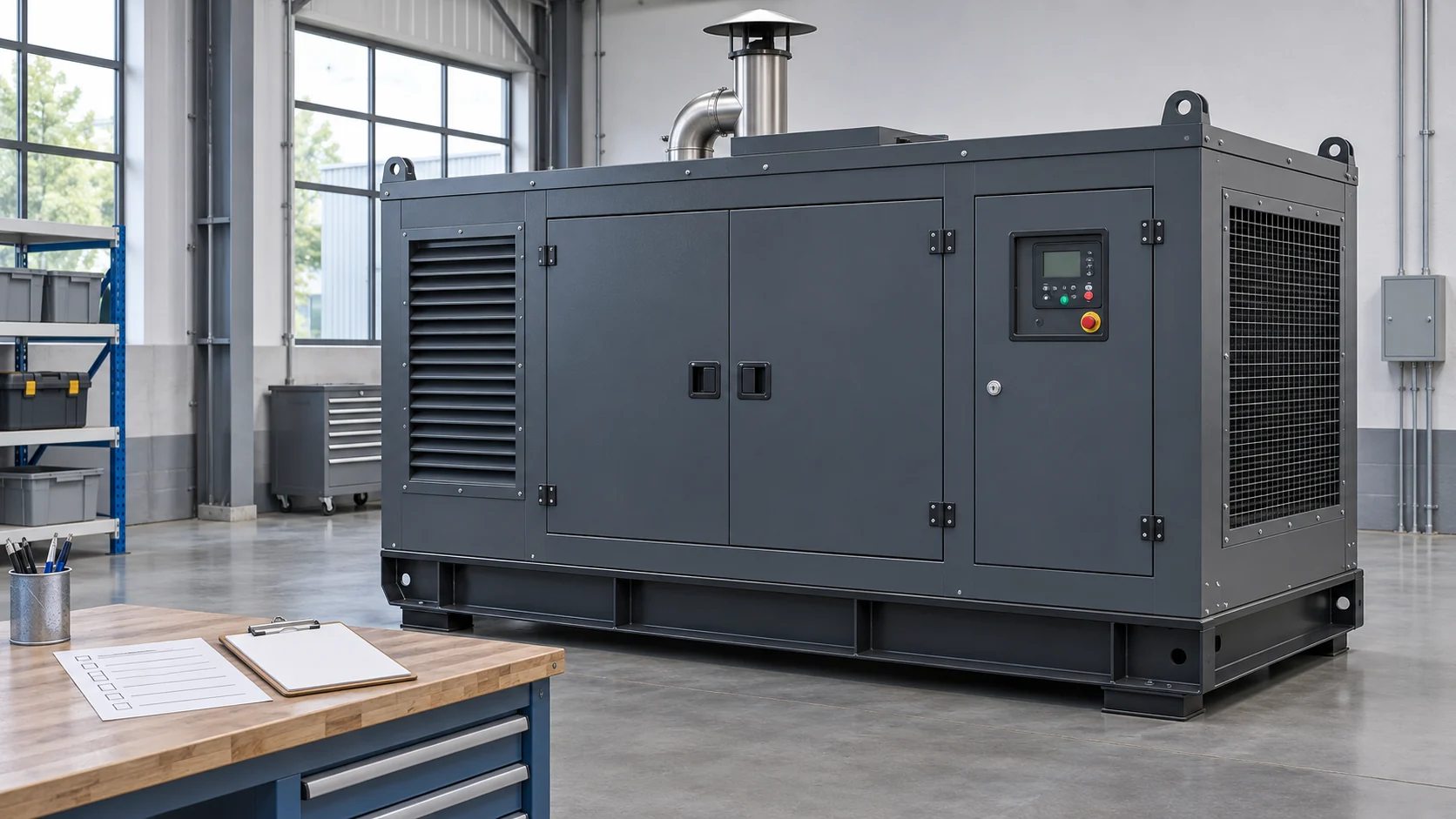



Checking the Complete 75 kW Package
Buyers checking a nominal 75kw generator must inspect the full delivered package. They should never rely on a bare engine rating or a single part.
A complete generator set, often called a genset, joins core parts into one unit. It pairs a diesel engine and alternator with a base frame, cooling, and controls.
Buying a 75 kw generator or a 75kw diesel generator requires checking every auxiliary part. An alternator alone is not a complete engine-driven generating set.
Engine output differs from net electrical power at alternator terminals. Buyers should check maker genset specs to confirm model, frequency, voltage, phase, and power factor.
Comparing model digits without checking parts risks buying an incomplete unit.
Electrical Units and Duty Ratings
Knowing power units prevents sizing errors when buying a diesel generator set. Apparent power uses kVA, while real power uses kW.
In math, kilowatts equal kilovolt-amperes times power factor. If a maker assumes a 0.8 power factor, a 75 kW load equals 93.75 kVA.
This calculation is an illustration, not proof every 75 kW unit shares that rating. The two match only at unity power factor.
Published duty ratings define clear working limits. In Caterpillar rating guide, standby, prime, and continuous categories reflect separate maker conditions.
Standby generators support industrial facilities during a power outage. However, commercial generators are not a duty class.
A set may carry more than one declared rating, but not all units do. A standby rating alone never proves prime or continuous capability.
Buyers must match the exact maker rating to the job. They must separate prime variable-load use from continuous steady-load duty.
Running and Starting Loads
Choosing an industrial generator requires checking running demand and transient load steps. Engineers must review the running load schedule with motor start data, methods, and sequences.
Sizing must account for load steps and phase balance. The review must also cover nonlinear loads, UPS loads, and allowed voltage and frequency shifts.
On construction sites, load steps and unbalanced phases heavily affect generator size. The Caterpillar sizing guide offers clear guidance.
It shows that sizing must check running demand alongside motor and HVAC starting demand.
Sizing tools help estimate demand, but calculators can miss harmonics or power factor shifts. Critical results require engineer review across diverse power sources.
A sound power solution matches maker transient data to actual site loads. Buyers must never rely on running kW totals alone.
Checking Site Conditions and Fuel Systems
Site conditions decide whether a diesel genset runs within maker ratings. Engineers must check ambient temperature, elevation, cooling airflow, and exhaust backpressure against maker limits.
They should not assume universal loss factors. Planners must pick fuel type based on infrastructure and what is on site.
Comparing diesel and natural gas requires looking at separate setups under matched duty. Natural gas generators do not all draw from utility pipelines.
Planners must check gas supply against maker inlet conditions. By comparison, a diesel generator runs on diesel fuel stored on site in an appropriate fuel tank setup.
Fuel and tank layouts must meet site and maker rules. A fuel efficient claim requires exact-model fuel-use data under stated operating loads.
Buyers must review features that generators offer to confirm airflow and fuel systems fit the job.
The Procurement Record
Buying an industrial genset requires keeping a single clear record before signing contracts. Marketing labels like powerful generator, heavy duty build, or high quality package do not prove performance.
Buyers must base purchase reviews on the maker’s current datasheet revision.
The comparison record must list the complete package. It details rated electrical kW and kVA, duty rating, frequency, phase, voltage, and power factor.
The record lists load schedules, motor start steps, and site limits. It details the fuel tank scope, unit controls, and transfer equipment scope.
It also records the reviewer name and key project assumptions. Finally, it notes any open deviations from the requested build.
This record helps teams review the offered package using recorded evidence. It grounds the purchase in verified data rather than marketing labels.