


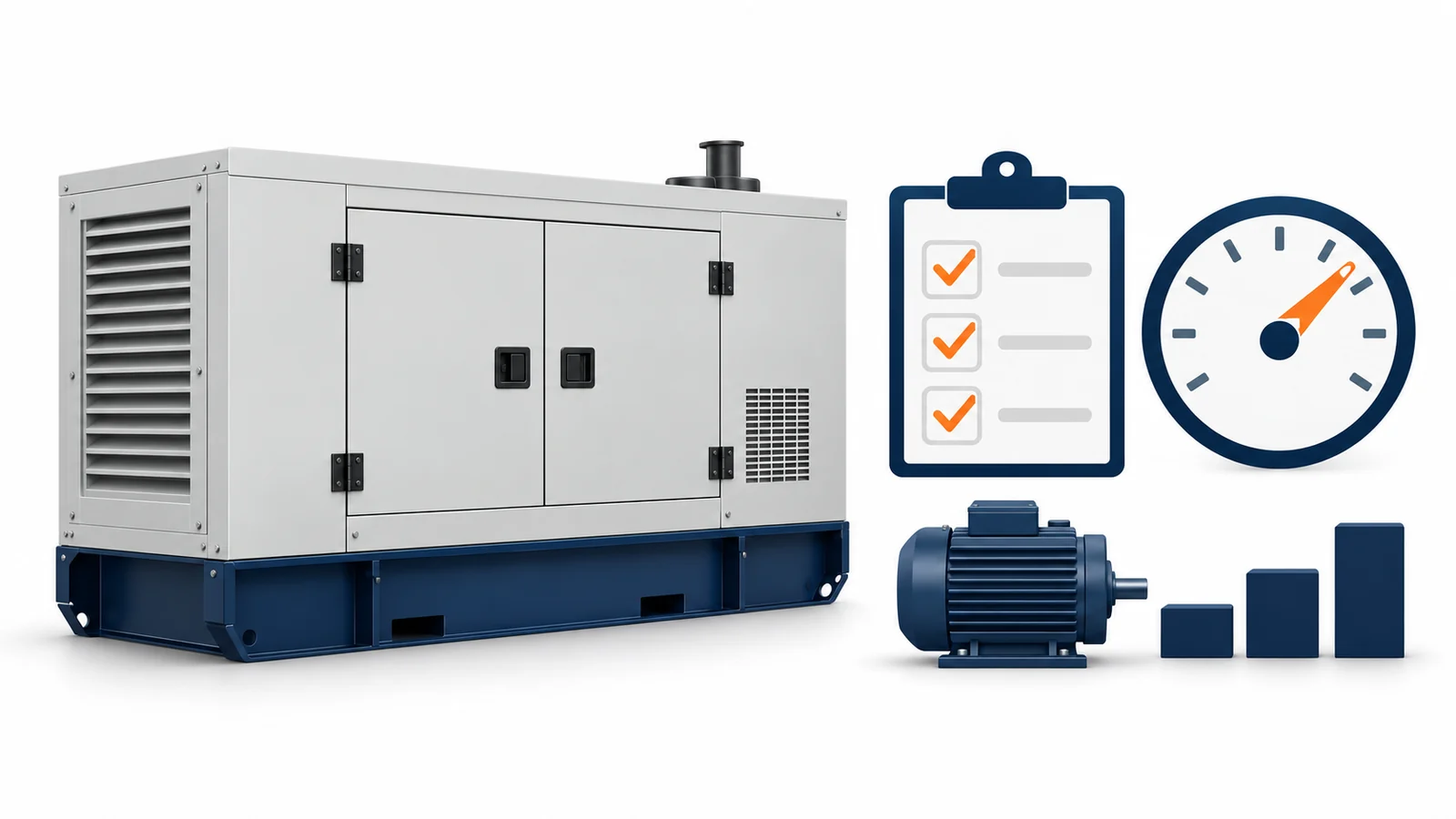



Check the duty behind the rating
Compare each 100 kW diesel generator proposal with the actual load study. A 100 kilowatt generator provides backup power during a power outage. Its ratings and load response must suit the actual project.
Begin with the maker’s duty limits. A standby label does not prove that the industrial genset has a prime rating.
Cat’s D100 GC product data identify a 100 ekW, 60 Hz standby generator set. These data describe Cat diesel generators. They do not define a SEER POWER model. Compare power outputs under the same declared conditions.
Separate kW, kVA and current
For a 100 kW generator calculation, assume a power factor of 0.8. Under this stated assumption, the kVA value is 125. Conversely, 100 kVA at that factor gives 80 kW. The two labels are not equivalent.
The current formula for a balanced three-phase load is I = (kW × 1,000) / (√3 × V × PF). In this formula, V denotes line-to-line voltage. The symbol PF is the power factor used in this balanced-load current example.
The assumed 0.8 factor and 480 V supply give about 150 A at 100 kW. The example estimates the load current only. Cable and breaker choices need a separate electrical design.
Request the actual voltage and number of phases. A single phase version needs its own rating. The three-phase output does not prove that rating. Our three-phase load checks cover the electrical basis.
Review starts and complete packages
An industrial generator must support running loads and starting events. Record each motor’s starting method and demand alongside the loads already running. A total below 100 kW does not establish an acceptable voltage or frequency response.
Cummins’ generator selection guidance treats engine and alternator response together. Ask for a load study for the selected genset. Confirm how generators perform against the agreed voltage dip, recovery and load sequence. A heavy duty label cannot replace this evidence.
Compare what generators offer in cooling, controls and installation scope. Check sound attenuation alongside enclosure airflow and service access. Delivering reliable supply requires an agreed design and test process. Retain the load study for long term changes.
Plan safe installation
Engine exhaust contains carbon monoxide. Operators must not run portable generators indoors. You may install a fixed industrial generator in a dedicated generator room designed for the selected equipment. The room needs suitable ventilation, exhaust discharge and fire protection under applicable local requirements.