





Define the Maintenance Objective
Standby generator maintenance includes servicing and capacity tests, whose objectives must be distinguished in the test requirements. Replacing oil or filters does not prove electrical capacity under load. An unloaded start does not confirm the ability to supply the intended loads either.
A standby generator is a backup power source; a load bank provides a controlled load for assessing its capacity. The contracted scope must identify the electrical-supply components included in the test and the functions that remain to be checked.
The generator set converts the engine’s mechanical energy into electrical energy through the alternator. In an engine-driven set, the internal combustion engine is the prime mover. Tests must respect both machines’ declared ratings and the operating conditions of the complete set.
Separate Real and Apparent Power
Real power is expressed in kW and apparent power in kVA, related by kW = kVA × PF. A technical review of the industrial generator needs its declared ratings and the test’s actual power factor. A rated power factor of 0.8 is a stated condition, rather than a rule for every load.
As an explicit example, a set rated at 500 kVA and 400 kW has a rated power factor of 0.8. Applying a 400 kW resistive load means 400 kVA at unity power factor. It does not reach the set’s declared 500 kVA rating. That difference does not permit imposing 500 kW on the example’s prime mover.
The Avtron guide to combined load tests distinguishes these demands. Reaching the real-power rating does not establish rated alternator current when the alternator’s rated power factor is below unity. Reports must state both power quantities and the tested conditions, with conclusions limited to the capacity established by those measurements.
Compare Resistive and Reactive Banks
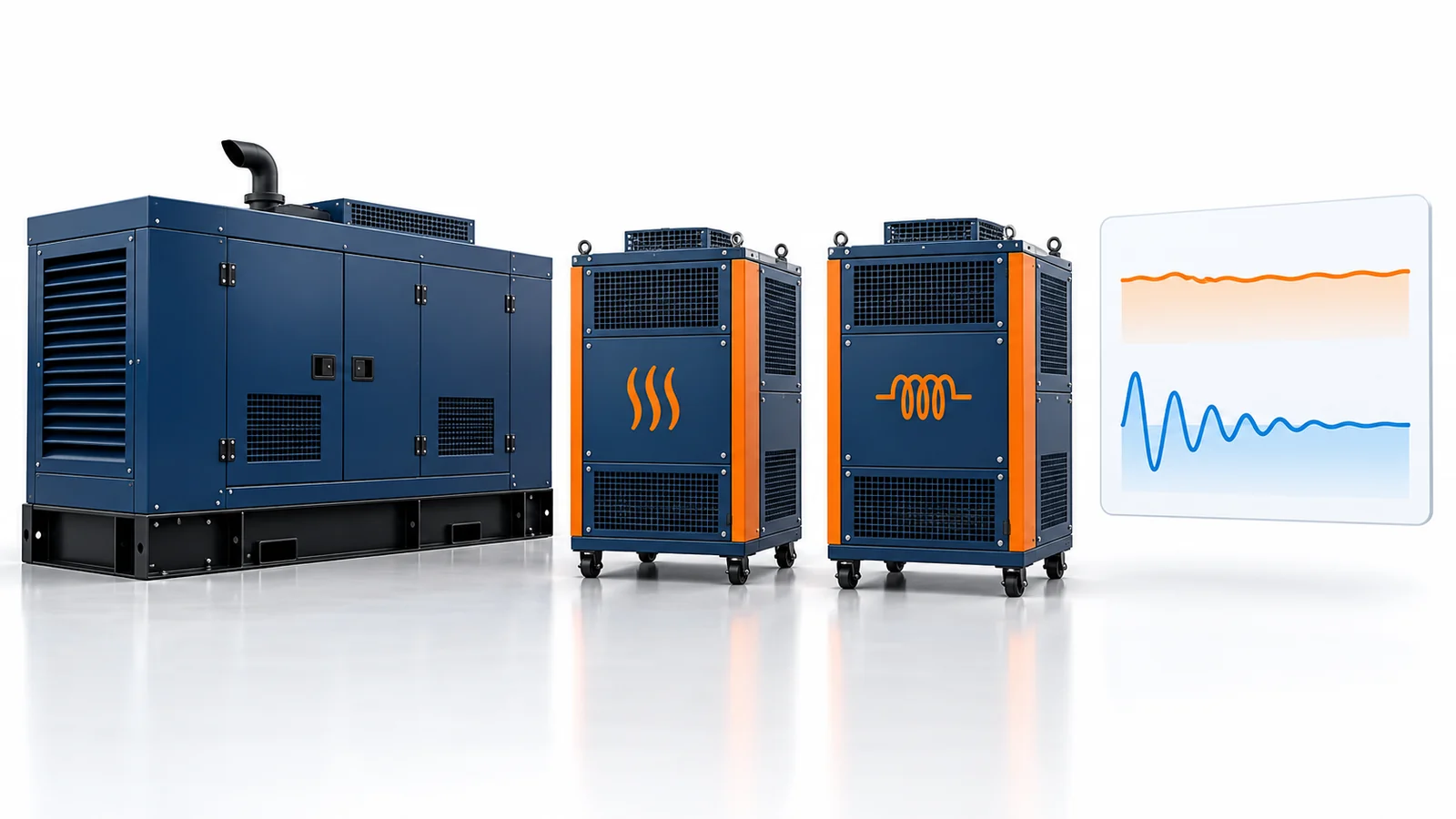
A resistive bank converts real power into heat and operates at a power factor close to unity. It can assess the prime mover under real-power demand, without proving every response to reactive power. Bank cooling and air discharge must suit the intended operating conditions.
Inductive coils create a magnetic field and produce a lagging power factor, with current lagging voltage. A combined bank incorporates resistive and inductive elements to assess the industrial generator set. Test requirements must respect the set’s power and current limits and the project site’s conditions.
The Avtron guide to load-bank types also describes capacitor banks, whose current leads voltage, with the opposite effect to an inductive load. Reactive therefore does not always mean inductive, and selection requires a compatibility review. Changing power factor requires a design approved for the equipment and intended condition.
Prepare the Site Test
Generator maintenance must follow the manufacturer’s technical manuals and the service plan and records. Preventive maintenance and the load testing described by Cummins serve different purposes. The technical plan defines responsibilities, initial conditions and requirements for returning to service. Intervals must suit the model and operating duty.
Before testing, the technical team assesses the engine’s condition and checks oil levels, fuel, air filters and the exhaust system. Findings need a technical decision before the test, since applying load is not a universal repair. The guide to common diesel generator problems helps organize that review.
Record fuel type, model, declared power, voltage and frequency, together with the bank’s effective capacity. The approved technical plan defines connections, isolation, protection and heat discharge. Competent personnel carry out these tasks under site rules; comparing power ratings does not replace electrical design.
Record Results and Limits
The report must identify the generator, bank and instrument models, along with measured kW, kVA and power factor. Record current, voltage, frequency and the duration of each test condition, as well as the ambient conditions and thermal readings. Keep available alarms and trends, distinguishing ratings from actual measurements.
Fuel-consumption data must include the measurement method and conditions, without extrapolating an isolated value to future consumption. Service life and standby power also depend on the condition of batteries, fuel and controls. Tests do not guarantee freedom from faults during future power outages.
Compare measurements with the limits defined in the test requirements and assign responsibility for resolving differences. The report must identify untested conditions and supply restrictions. Returning to service requires restoring the intended states of controls and protection under the site’s approved rules.
Engine exhaust contains carbon monoxide. Operators must not run portable generators indoors. You may install a fixed industrial generator in a dedicated generator room designed for the selected equipment. The room needs suitable ventilation, exhaust discharge and fire protection under applicable local requirements.