





Starting Battery and Charger Roles
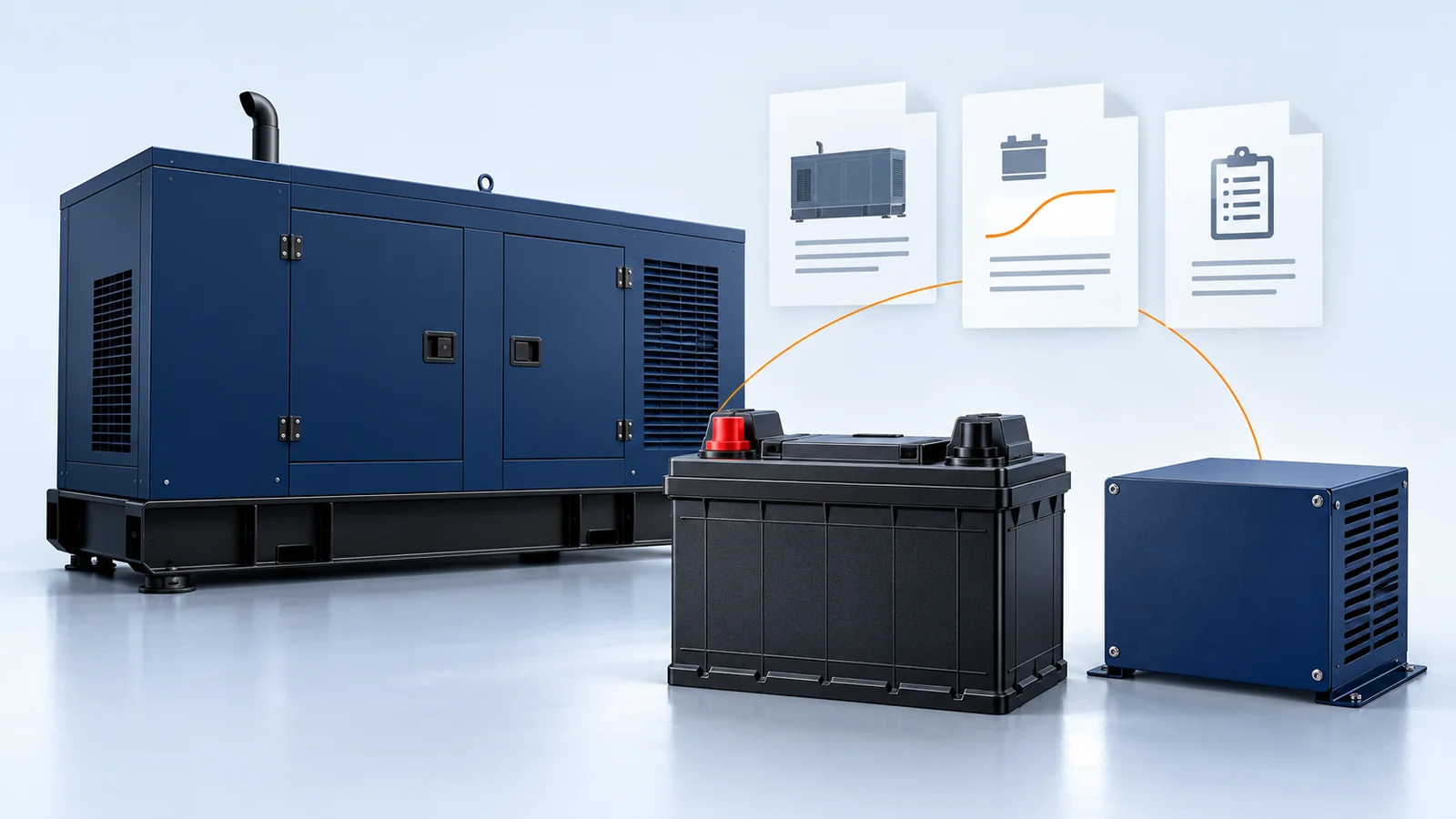
A trickle charger for generator battery service supports charge between engine runs. This guide covers stationary generators with electric starting. The generator set, or genset, uses its starting battery to crank the engine and supply controls. The bank does not supply the building’s main AC loads during a power outage.
Standby generators need a charging system that suits the installed bank. The same review applies to diesel generators and approved electric-start gas packages. The battery and charger still need their own checks. Carbon monoxide and other exhaust hazards require proper siting; battery charging never makes indoor engine operation safe.
Match the Bank and Charging Profile
Trickle means a small charging current. This term alone does not define the charging control method. Victron’s charger settings guide describes float as a reduced-voltage stage. Some products also provide a separate storage mode.
These are product examples. They do not prove that the charger suits a given industrial generator.
For an industrial genset, obtain the battery model, chemistry and bank voltage. Check those details against the charger manual and approved parts list. Record the charge profile and the battery types it supports.
Similar plugs or case sizes do not prove that parts match. A change in battery chemistry needs a fresh system review.
Account for DC Loads and Recovery
Cummins T-030, section 4.5.3, lists bank capacity, extra DC loads and recharge time among charger inputs. Include control loads for data centers and other critical sites. A transfer switch controller may draw from the bank if the actual design connects it there.
Review the charger’s AC supply, site temperature limits and cable route. Wire resistance affects the current that reaches the bank. The reading at the charger can differ from the current at the battery.
Qualified staff check these points against the exact site and equipment documents. The approved plan should also cover recharge after the required starting cycles.
Keep Clear Equipment Records
Each bank and charger needs a clear equipment record. List model numbers, manual dates, approved settings and the staff assigned to checks. Note any parts that differ from the agreed package. Resolve missing details before choosing a new unit.
Assign an owner and due date to each open question. Keep written supplier replies with the record. Future reviews can then trace the choice and its stated limits.
Commercial generators offer different battery and control packages. Compare the actual records instead of assuming that all units have the same needs. Keep changes within the standby maintenance plan. For long term records, retain test conditions and completed service work alongside alarm history.
Verify Starting Performance
A charger light shows the state that the unit reports. It does not prove that the bank can start the engine. Caterpillar’s battery testing guidance separates charge checks from a load test. Its test numbers apply to the stated battery test.
They are not limits for every starting bank.
Qualified staff follow the exact manuals and site energy-control rules. Records should show the test method, battery temperature, results and work still due. Persistent slow cranking requires checks of the complete starting circuit.
The common generator faults guide covers other causes and the roles of site staff. A passed check helps staff assess the system. A successful test does not guarantee subsequent engine starting.