


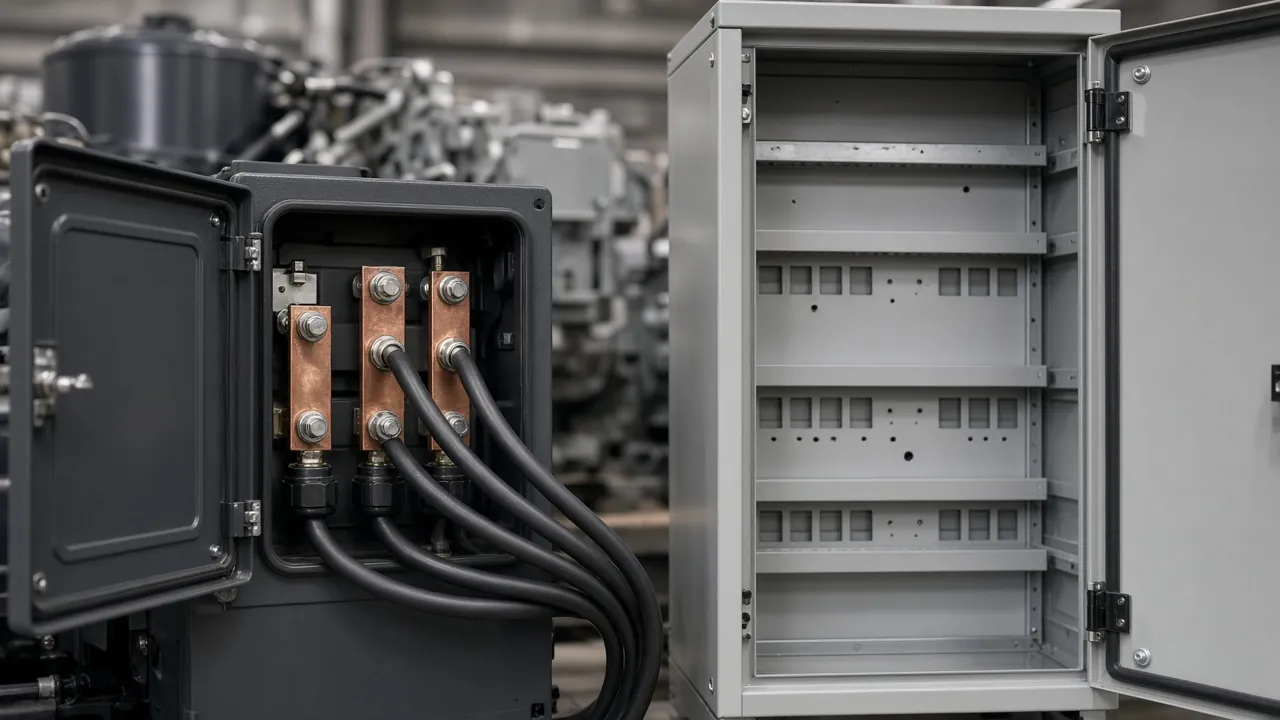



What “240V” means on a generator
Choosing a 240v electric generator begins with verifying the phase configuration and voltage on your main service panel. In the United States at 60 Hz, a 240v generator usually gives split-phase 120/240 V single phase power. This three-wire configuration provides 240 V across the two energized lines and 120 V from either line to neutral.
Some businesses use three-phase 240 V service, which needs a three-phase genset (generator set) wired for that board. Before buying a generator with 240v output, ask your electrician to verify the panel label and neutral bond. Matching the alternator winding to the facility prevents unsteady voltage and equipment damage during a power outage.
Current per kW at 240 V
Once you know the phase type, find the line current of a 240 v generator with simple formulas. The real power formula is kW = kVA × PF. Use PF = 0.8 only where it is the declared equipment rating or an explicit calculation assumption.
Use the load’s actual power factor and starting characteristics for the load study. To estimate current, divide watts by volts times power factor. For three phase current, also divide by 1.73.
- Single phase, 240 V, PF 1.0: 10 kW is about 42 A; 20 kW is about 83 A.
- Three phase, 240 V, assumed PF 0.8: 10 kW is about 30 A; 20 kW is about 60 A.
These values assume a balanced load without derating or additional margin. Because single phase output depends on the model and winding link, check amp ratings with the builder.
Matching the panel and the transfer switch
Linking an electric generator 240v feed to a building must go through an approved transfer switch. A licensed electrician installs this switch to cut off grid lines before the backup generator feeds the board. Never connect a unit to a household outlet or wire unswitched conductors to a panel.
The switch gear must match the voltage, phase count, 60 Hz rate and amp rating of the panel. Your electrical engineer also evaluates motor starting surges so the standby generator accepts the load smoothly. Good panel matching brings reliable power and peace of mind when the grid drops.
Portable, inverter, home standby and industrial units
Buyers will encounter 240 V power outputs across several equipment categories. Small portable generators and compact inverter generator units support hand tools or appliances, not commercial facilities. A residential home standby generator uses a smaller engine for intermittent household loads.
For commercial buildings, farms and industrial sites, use an industrial generator with a liquid-cooled diesel engine. That configuration suits extended operating hours.
SEER POWER manufactures industrial diesel units with generators ranging from 30 kVA to over 1875 kVA. The product catalog presents the complete range.
The 30–125 kVA diesel series delivers about 24 to 100 kW prime at 50/60 Hz in open, canopy or trailer builds. The SP-30WC delivers 30 kW prime (37.5 kVA) and 33 kW standby (41.3 kVA). SEER POWER configures it with voltage options from 220 to 480 V for each project. It pairs a Weichai WP2.3D40E200 engine with a Leroy-Somer or SEER POWER alternator.
Where a property has reliable pipeline supply, a natural gas generator performs well. Propane from on-site tanks is also a practical option. For natural gas or LPG power projects, contact SEER POWER. Share your load, voltage, operating duty and fuel-supply details to discuss the configuration.
Fuel, enclosure and controls
Fuel type depends on local storage regulations and utility lines at your property. A diesel generator stores diesel fuel on site in a sub-base fuel tank sized on the model datasheet. Check datasheet fuel use at your expected load to see if a model is fuel efficient.
Outdoor installations use a sound attenuated canopy. It protects internal components and directs cooling airflow. See our guide on enclosures and airflow. Digital control panels monitor voltage, 60 Hz frequency, oil pressure and start signals from the transfer switch.
Engine exhaust contains carbon monoxide. Operators must not run portable generators indoors. You may install a fixed industrial generator in a dedicated generator room designed for the selected equipment. The room needs suitable ventilation, exhaust discharge and fire protection under applicable local requirements.
What to ask the supplier
When requesting a quote, specify standby backup or prime power for off-grid operation. Ask the supplier to confirm 60 Hz output, the 240 V wiring link and the single-phase kW rating on the datasheet. Reviewing these specifications early prevents common diesel generator issues and aligns with our industrial power solutions.