


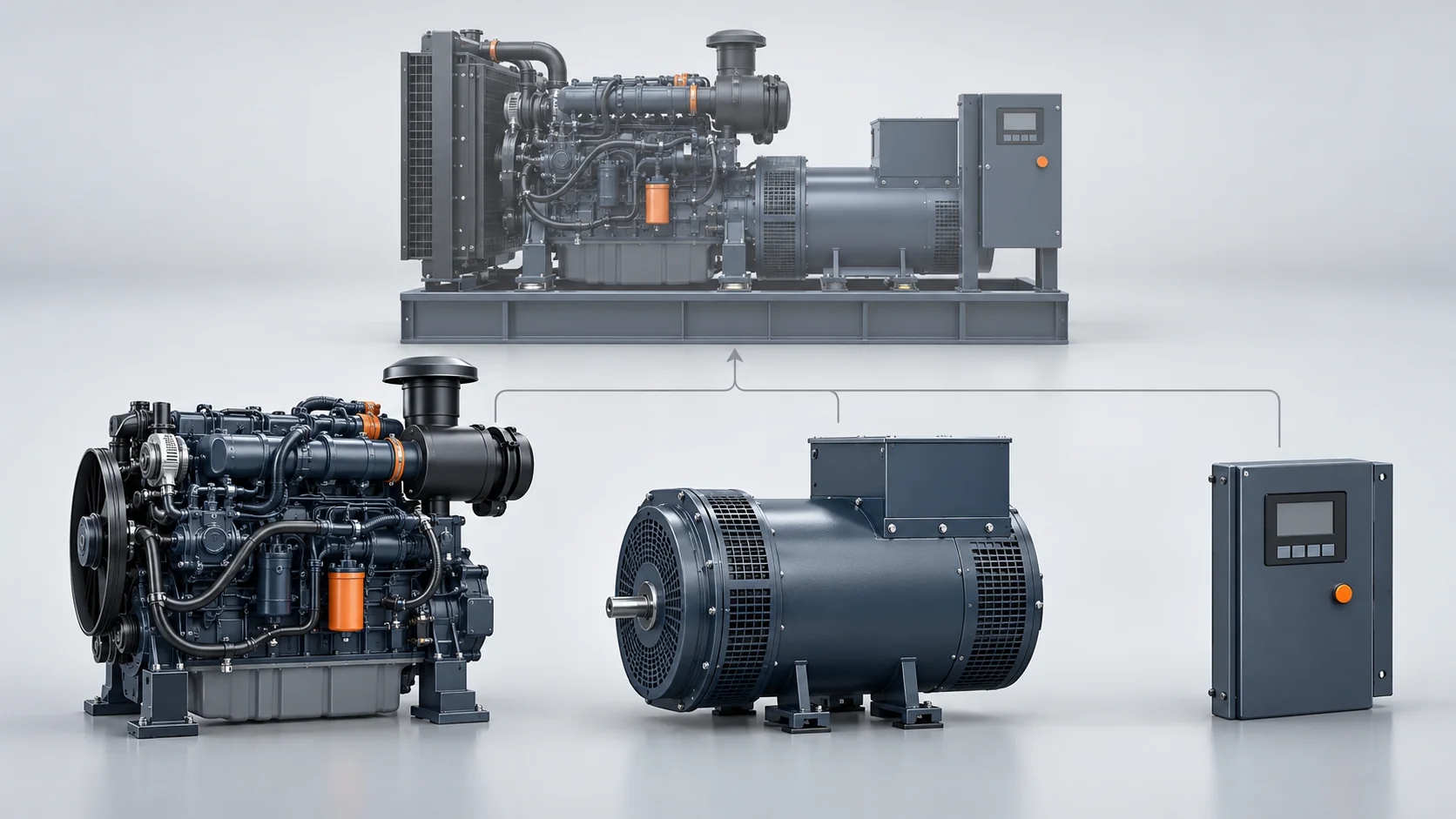



A Complete Manufacturer’s Set or a Package With a Cummins Engine
Assessing a Cummins generator set requires a distinction between a complete manufacturer’s unit and a package assembled by a third party. On its regional website, Cummins states that it designs, manufactures and tests its own complete sets integrating the engine, alternator and controls.
Other assemblers combine engines from this brand with components from different suppliers on their own frame. That integration does not establish that Cummins manufactured the complete set.
For an industrial generator set assembled by a third party, the customer should not assume a single scope of coverage. The engine brand does not establish support for the alternator, frame or control panel. Assessing an offer to supply reliable power requires identifying who is responsible for the complete package. The buyer should request the documented technical coverage for each component in writing.
Understanding how an electrical generator works helps distinguish the functions of the components in generator quotations. An industrial generator assembled by a third party requires technical documentation for the included components.
For equipment installed permanently, the buyer should check the components and their specifications with the local supplier. Selecting a suitable generator type requires checking the manuals for the complete set as well as the engine.
Technical Specifications, Energy Conversion and Operating Rating
In each generator set with an internal combustion engine discussed in this guide, the engine provides the mechanical power that drives the alternator. The alternator converts mechanical energy into electricity through the rotating rotor and magnetic fields. The manufacturer may specify altitude or temperature limits for the model. Where those limits apply, compare the datasheet’s power rating with the plant load.
Fuel type depends on the factory configuration of each version. A diesel generator should be assessed against the power rating declared for its model. For industrial applications, request fuel consumption data for the intended loads. Service life depends on use and maintenance; it is not a fixed promise from the brand.
The QSJ8.9G series documentation includes natural gas variants and propane options at 125 kW and 150 kW. The buyer must check the configuration and permitted fuel in the specification for the model offered.
Datasheets list power in kVA and kW, voltage and phases. As a reference, the specification for the C20D5P in the X1.3 series declares an apparent power rating of 20 kVA. The rated power factor stated for that model in India is 0.8. This is a local model specification. It does not represent every generator set from the brand or a standard for Peru.
Reviewing the causes of high diesel consumption helps compare the stated consumption with possible deviations during daily operation.
Comparing Plates, Serial Numbers and Technical Documents
To check the equipment, compare the models and serial numbers on the available identification plates with the commercial quotation and the components supplied.
For a third-party package, the buyer should request information from both the engine manufacturer and the assembler. The engine’s serial number does not establish the origin or support of the other components. Ask the supplier for the unit’s technical documents and the method for checking each code.
The documentation should include the engine manual, alternator datasheet and control diagrams. A serial number alone does not establish the origin or support of the remaining parts. Before buying, request the support scope and manuals for each component in writing.
Generator systems require careful document checks before handover. Guides on common issues with diesel generators provide technical background on common operating faults. This information does not replace service manuals or authorize direct work on the equipment.
Backup Power, Automatic Transfer and Operational Continuity
A backup generator provides an alternative source of power when the electrical service fails. As part of the power system, it supplies the assigned loads.
The backup system must meet the conditions of the installation. In rural areas, check the availability of fuel and technical support. Projects do not all use the same controls or starting arrangements.
When assessing an emergency generator set quotation, request the operating rating, service conditions and limits documented by the manufacturer.
The backup arrangement may include an automatic transfer switch and its control module. This control monitors the line and detects loss of the grid supply.
The system then sends the start command, and the transfer mechanism switches the load to the generator. When the external grid returns, the system reconnects the load to the grid if the design permits. The buyer should request the control logic and switchboard manuals from the supplier.
Operational continuity in hospitals and data centres depends on the installation’s complete electrical configuration, rather than the engine brand.
A project intended to provide continuous power must specify the interruptions its loads can tolerate. Assessing backup power requires documented operating conditions and technical coverage for each item of equipment.