





What an Emergency Generator Must Cover in a Building
Installing an emergency generator in a building, retail facility, or office in Mexico protects essential services during utility outages. When the public power grid fails, the facility must maintain occupant safety and keep priority equipment running.
A generator set uses an engine to turn an alternator. The alternator makes power by electromagnetic induction. Its magnetic field induces a voltage, and the set delivers 60 Hz current to the site.
The goal is to keep essential circuits live during a grid outage. Continuous plant duty under a prime rating needs a separate guide. Commercial and residential buildings need standby backup. The right standby generator avoids both outages and oversizing.
Separate Critical and Non-Critical Loads
Sizing starts with a written load list that sorts circuits into critical and non-critical loads. In a building in Mexico, critical loads include elevators, water pumps and emergency lighting. IT equipment and essential refrigeration also count.
You can leave out comfort cooling or outdoor signs to make better use of the generator’s capacity. The electrical engineer does this survey by checking the existing panels. A separate emergency panel for priority circuits makes load control simpler when the standby generator starts. The set then runs with a predictable load.
Standby Rating and Power Output
Buildings on the public grid usually specify a standby rating. This rating fits a unit that waits on standby and supplies power during limited outages.
The real power formula is kW = kVA × PF. Use PF = 0.8 only where it is the declared equipment rating or an explicit calculation assumption. Use the load’s actual power factor and starting characteristics for the load study.
When summing critical loads, account for the higher starting current required by pump and elevator motors. The supplier must verify that initial inrush peak, while the electrical designer establishes the reserve margin.
SEER POWER product ranges cover from 30 to 1875+ kVA.
The 30 to 125 kVA industrial diesel series delivers between 24 and 100 kW prime. This line includes the SP-30WC, rated at 30 kW prime (37.5 kVA) and 33 kW standby (41.3 kVA). A Weichai WP2.3D40E200 engine drives a Leroy-Somer or SEER POWER alternator.
For higher capacities, see the 125 to 375 kVA series and the 375 to 750 kVA series.
Automatic Start and Transfer Time
A backup power system uses an automatic transfer switch (ATS) linked to the controller. When the controller detects an outage, it sends a start signal to the engine. Once voltage and frequency settle at 60 Hz, the switch connects the critical circuits.
The project engineer sets the maximum transfer time based on how sensitive the loads are. For servers that cannot accept any break, installers add UPS batteries to cover the first seconds. If the building requires two synchronized units, review our guide on generator synchronizing modules and paralleling.
Fuel Type and Runtime
Your fuel choice depends on space and local utility lines. Diesel sets keep fuel in a tank on site, so runtime depends on tank size and load. Gas units are practical where the site has a reliable natural gas line or LPG supply.
For natural gas or LPG power projects, contact SEER POWER. Share your load, voltage, operating duty and fuel-supply details to discuss the configuration. Both fuels give reliable backup power when you size the set to the real load.
Once you know the runtime hours you need, you can size the fuel tank or confirm the gas pipe capacity.
Location, Exhaust System, and Service Life
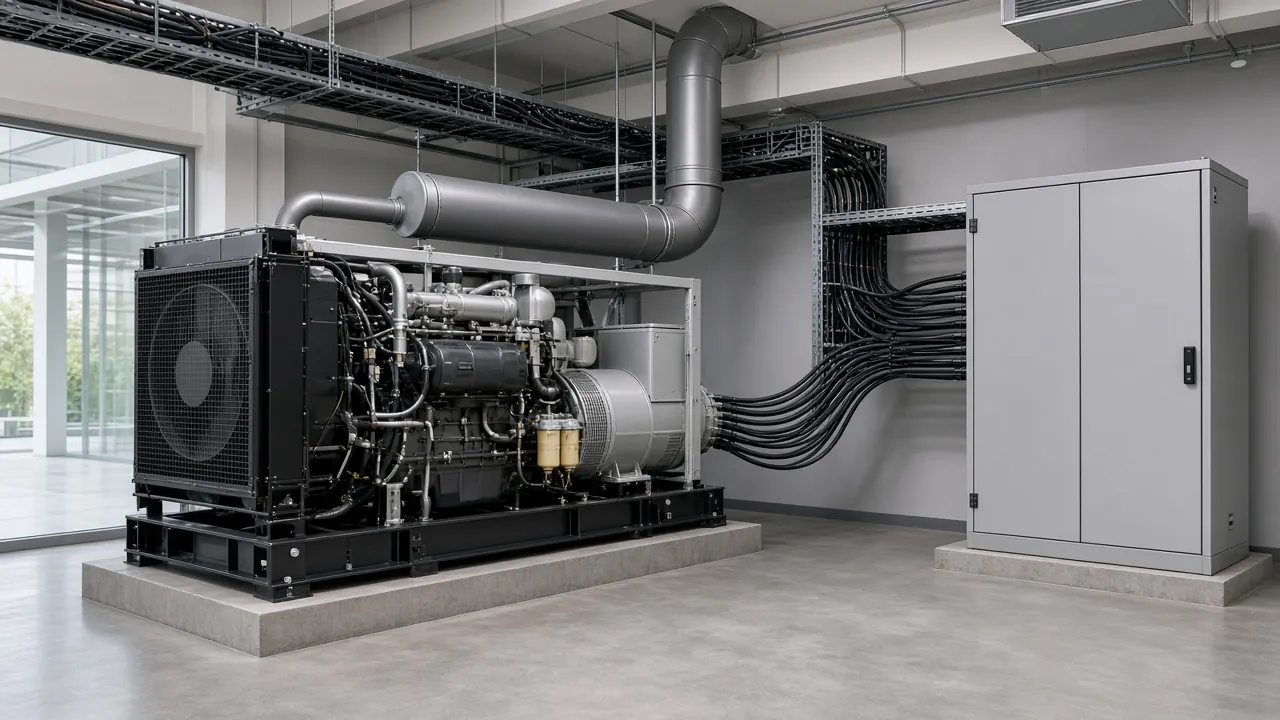
Engine exhaust contains carbon monoxide. Operators must not run portable generators indoors. You may install a fixed industrial generator in a dedicated generator room designed for the selected equipment. The room needs suitable ventilation, exhaust discharge and fire protection under applicable local requirements.
For open units in a plant room versus outdoor enclosures, see our guide to generator enclosures, airflow, and noise.
Service life depends on regular test runs and on avoiding common diesel generator issues. Clear space around the unit also lets technicians check filters and batteries safely.
What to Request from the Supplier
Before you ask for a quote, confirm with your designer whether the panel runs at 127/220 V or 220/440 V at 60 Hz. The SEER POWER 30 to 125 kVA series offers voltage options from 220 to 480 V for each site. Always ask for the datasheet with the standby rating and the alternator’s declared power factor.
You can also review enclosures and controllers in our backup power solutions.