


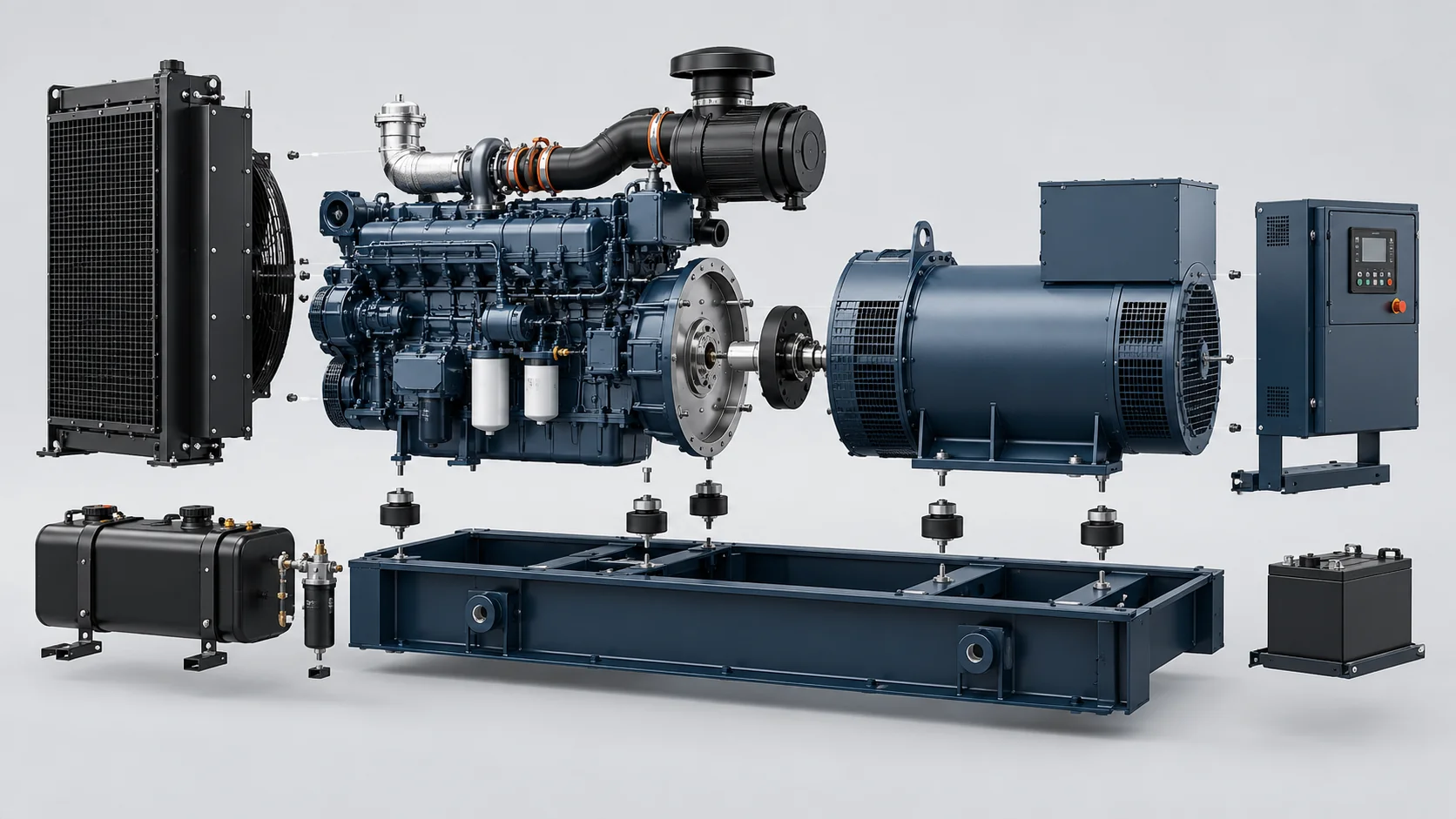



Engine and Alternator: The Core of Power Generation
Knowing diesel generator components helps buyers choose the right unit for industrial facilities. In these combustion engine units, an engine and an alternator sit on one base frame. They supply electrical power when the main grid fails.
In technical sheets, the word generator often refers to the alternator. A generator set, or genset, is the full package with its engine and controls. Because sales quotes may use both names for the same unit, always check the exact quote scope.
The engine provides rotary mechanical motion at the shaft. Fuel burns in the cylinders to drive the pistons and turn chemical energy into shaft rotation.
Many plants use diesel engines for site power generation. Makers such as Cummins also list natural gas models in factory sheets. No fuel guarantees continuous supply by itself, so ask the maker for declared model power outputs.
Driven by the shaft, the alternator acts as an electric generator. It converts mechanical energy into electrical power for the load. In these industrial AC units, relative motion between a magnetic field and conductors induces voltage in the stator.
Not every electric generator uses the same rotor build, and alternator design and tolerances vary by duty. Always request the model sheet and nameplate data instead of assuming uniform tolerances.
Cooling, Exhaust and Fuel Systems
The engine needs support circuits to remove heat, vent gases, and supply fuel.
The cooling system removes heat from the engine while it runs. Depending on the model, it may use a radiator and fan or a heat exchanger if the model sheet lists those parts. Buyers should check which cooling parts the maker documents for the quoted unit.
For example, the July 2018 Cummins X1.3 India sheet is Revision 3. That sheet lists a radiator circuit only for the versions on that sheet. Models do not all share the same parts or high-heat shutdown actions. Buyers should check the model details in the quote.
The exhaust system carries gases through pipes and a silencer to the outside air. Discharge routing must follow the project design and the model manual.
Engine exhaust contains carbon monoxide. Operators must not run portable generators indoors. You may install a fixed industrial generator in a dedicated generator room designed for the selected equipment. The room needs suitable ventilation, exhaust discharge and fire protection under applicable local requirements.
The fuel system manages the fuel supply to the engine based on its factory version. Diesel units normally use a fuel tank, pumps, and filters. Factory natural gas models use gas regulators and shutoff valves when listed for that version. Do not assume shared parts, dual fuel use, or field conversions.
Fuel burn depends on the connected load and site conditions. Teams can compare site run logs with factory fuel data under similar loads. The guide on causes of high diesel consumption offers supporting context, not an automatic fault check.
Control Panel, Starting System and Base Frame
Running the unit requires sensor controls, a starting system, and a base frame.
The control panel reads unit sensors and accepts start signals listed for that model. Models do not all log the same values or use the same shutdown actions. Buyers should ask which signals and readings the panel supports.
A controller may include start or mains failure logic, but the project transfer device physically switches the load. That physical switching stays separate from engine sensor monitoring.
Where a model has factory electric starting, it uses a starter motor and battery to crank the engine. Chargers and other auxiliary parts depend on the written contract. For operating faults, the guide on common issues with diesel generators gives background on typical equipment problems.
The base frame joins the engine and alternator and supports the whole set. The July 2018 Cummins X1.3 India sheet lists a fuel tank in the base frame, while other models use separate tanks.
If a quote offers a sound attenuated enclosure, it may be an option. Buyers should check the package scope instead of assuming all units include one. Request the full parts list and supply scope.
Generator Set and the Installation's Electrical System
Buyers should separate the unit's own parts from the building's electrical gear.
An industrial generator set includes the equipment inside its factory package. It supplies power at its output terminals to feed assigned loads. Some projects place the transfer gear on the unit, while others install it in the main switchboard.
During a grid power outage, standby generators act as a site power source to provide backup power. If the project specifies an automatic transfer switch, it switches the load between the grid and the unit. The main power path runs through that switch, not through the engine controller.
From a stopped state, the engine requires time to start and accept the load. The generator alone cannot guarantee power without a break. Ask for the transfer logic and system response data.
In industrial plants, a backup unit aims to support designated critical loads. Still, its presence does not guarantee the same response to every external disruption. A qualified project lead must compare the site loads with the manuals. That lead should also check how the unit connects to the internal electrical system.
Technical Criteria and Operating Limits
Safe generator operation requires following the limits in the factory manuals.
Preventive maintenance must follow the schedule in the equipment manual. Checking fluids, hoses, batteries, and filters with qualified technicians helps protect part life. These tasks lower mechanical risk, though they do not guarantee zero faults or a fixed lifespan.
If a supplier uses the phrase "we supply power," ask for the equipment and service terms in writing. Where the maker declares altitude or temperature correction factors, request those data to check site power outputs. Checking a data sheet alone does not guarantee site capacity.
In continuous processes, an unplanned stop may cause economic loss depending on load priority. Reliable power supply depends on the full site electrical design as well as the nameplate rating.