


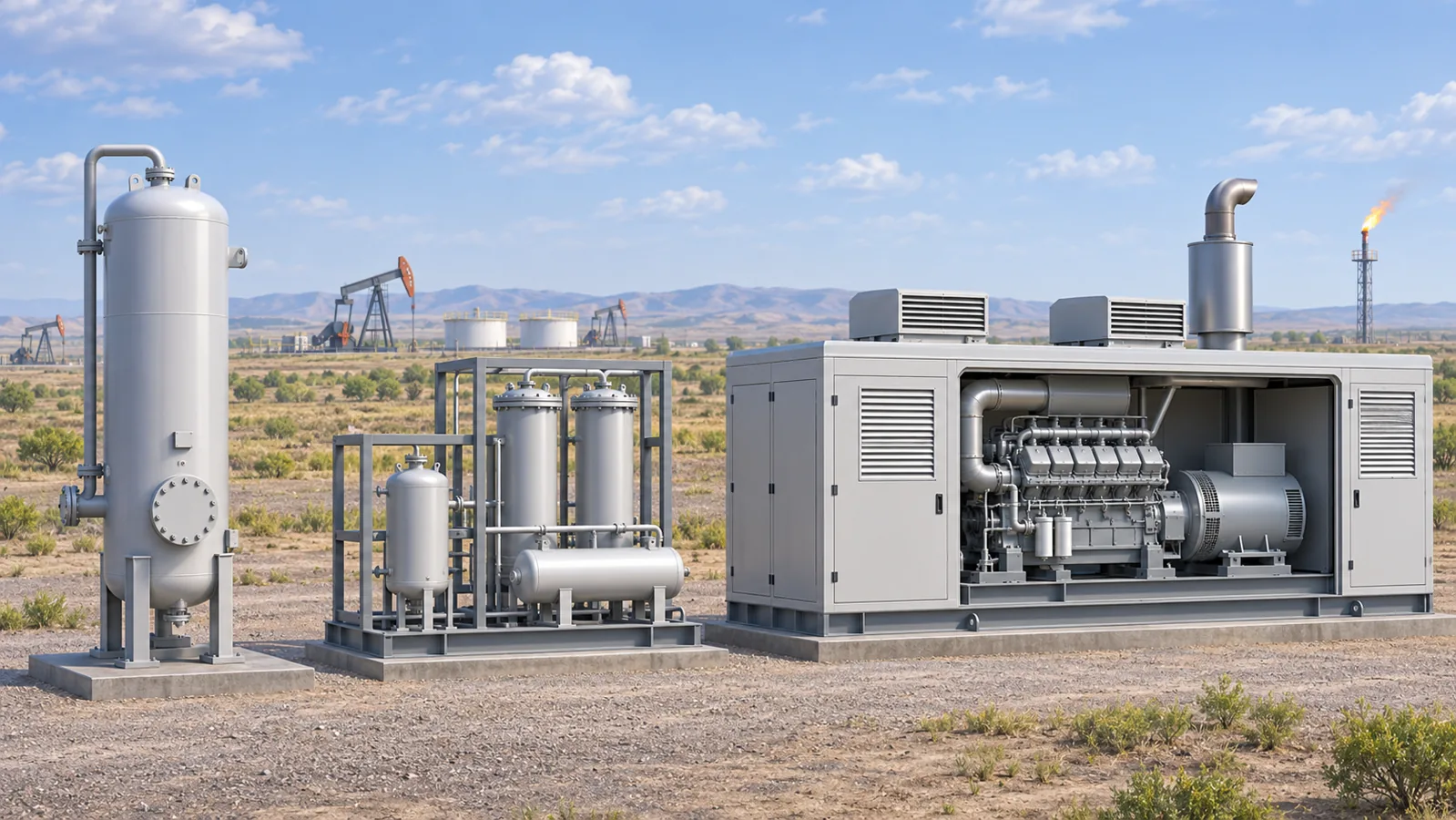



Flare Gas Sources and Safety Limits
Teams that plan flare gas power generation must first find the gas source. During oil production, crude oil releases associated petroleum gas (APG) in surface field separators. Sites without gas-gathering lines may assess flare gas recovery power generation for local electric power.
Usable gas flow and gas compositions change with field geology, water cut, and field age. A wellhead gas generator may use separator gas only after fuel tests confirm the fuel fits the engine.
The World Bank’s gas flaring explained guide splits routine gas flaring from safety flaring. Feeding qualified usable gas into an engine can help reduce flaring.
Qualified engineers must review source pressure, flow changes, process safety, and local rules. Approved safety flare and relief systems must remain independent and ready.
Fuel Testing and Handover
A flare gas to power setup needs good fuel tests before buyers pick a generator. A single spot sample does not show all site conditions or prove future conditions.
Testing covers methane, heavier hydrocarbons, and carbon dioxide (CO2). It checks total sulfur, H2S, liquids, and particles. Tests also verify lower heating value, knock resistance, water dew point, and hydrocarbon dew point.
Ethane, propane, and butane can lower methane number and increase knock risk even if heating value increases.
Under Jenbacher’s flare gas guidance, treatment depends on the project. Sites may need to dry gas, remove sulfur, and remove hydrocarbons that condense.
Engines may need derating compared with pipeline gas. No blanket rule sets a methane floor, sulfur limit, methane number, dew-point margin, or fixed derating.
Package Labels and Fuel Approval
Generator set and genset mean an engine generator package. It holds an engine, an alternator, controls, and a base frame. Flare gas generator, associated petroleum gas generator, and associated gas generator are vendor project labels, not three fuel standards.
Industrial generator, industrial genset, natural gas generator, and natural gas genset labels do not prove field-gas capability or fuel acceptance. The gas generator product range shows package choices, not raw or treated field-gas approval.
Every piston-type associated gas engine needs written fuel approval from the OEM or an authorized packager. This sign-off links treated outlet gas quality to the chosen engine. It covers combustion, compression ratio, ignition, and lube oil.
Engine controls can curb knock within design limits. They do not replace written approval and may not make up for off-spec gas.
Net Power and Site Setup
Sizing gas power generation starts by matching checked usable gas flow and heating value to site loads.
The OEM provides an engine rating based on treated fuel and site conditions. Engineers check altitude, air temperature, and engine minimum load. They must review flow and heating-value time series over expected field changes. Teams must allow planned service stops during site design.
Quotes for flare gas power generation solutions must state actual setup power loads. They must list scrubbers, dryers, chillers, booster compressors, radiators, and fans when used on the selected package. Engineers subtract these loads at the agreed boundary where they measure net power.
Brief flow peaks or nameplate kW do not prove a dependable net power supply.
Qualified engineers must review power systems, protection, and controls for the site. They check isolated or grid-export modes against local safety rules and grid rules.
Engine exhaust contains carbon monoxide. Operators must not run portable generators indoors.
Operators may install a fixed industrial generator in a dedicated room designed for the selected equipment. The room needs suitable ventilation, exhaust discharge, and fire protection under all local rules.
Heat Recovery and Project Costs
Any review of fuel efficiency must state the fuel input and useful energy output used.
Running an engine does not guarantee zero flaring, automatic emissions compliance, or a fixed payback date. Excess gas flows and routine service stops still need a safe route to an approved flare or recovery system.
Review confirmed gas rights, transport distance, fuel costs, gas-treatment costs, service costs, and operating costs.
Compare them against local electricity and useful-heat value to find possible cost savings.