





Why hospital generators are planned differently
Planning hospital generators takes more care than office buildings. Care teams cannot stop work when the grid fails. Even a short power outage can halt life support, surgical lights and key medical equipment. Patient care depends on those systems.
A small portable generator can support field tools and temporary work areas. A fixed hospital genset (generator set), by contrast, is one part of a full emergency system.
Code duties rest with the owner, the project engineer and the local authority having jurisdiction. Engineers use rules from the National Fire Protection Association to set site generator requirements.
These include the NFPA healthcare codes and the NFPA 110 standard. Site plans also cite NFPA guidance where the authority requires it. Makers supply clear datasheets so the engineer can check each hospital generator against local rules.
Define the essential loads and branches
Sizing a hospital backup generator starts with a written load study. In hospitals, engineers split essential power into life-safety, critical and equipment branches. This way the most vital loads connect first.
Life-safety and critical branches feed exit lights, alarms and operating rooms. These circuits also support ICU beds and nurse call systems.
The equipment branch runs larger motors, such as air compressors, vacuum pumps and elevators. The real power formula is kW = kVA × PF. Use PF = 0.8 only where it is the declared equipment rating or an explicit calculation assumption.
Use the load’s actual power factor and starting characteristics for the load study. For three-phase current, divide watts by 1.73 times volts times power factor.
Depending on total demand, teams may check the 375–750 kVA diesel series or the 750–1250 kVA diesel series. Our 1000 kW generator guide covers larger plants. Smaller clinics may use the 30–125 kVA series, rated about 24 to 100 kW prime at 50/60 Hz.
The SP-30WC delivers 30 kW prime (37.5 kVA) and 33 kW standby (41.3 kVA). It pairs a Weichai WP2.3D40E200 engine with a Leroy-Somer or SEER POWER alternator.
Transfer time and automatic transfer switches
Hospital power systems use several automatic transfer switches. Each branch then connects in order when grid voltage drops.
The project engineer sets the allowed transfer time under the health code that applies. Separate switches also spread out large motor starts. The standby generator then avoids one sudden load step.
Redundancy and paralleling
Many hospitals plan N+1 redundancy with two or more backup generators. Several generator sets can share one common bus. The site then keeps full backup capacity during service on one unit. Our guide on synchronizing modules and paralleling explains shared buses.
Fuel type, fuel tank and autonomy
Fuel type and storage layout matter when you compare backup power solutions for medical sites. A diesel generator with an on-site fuel tank stores diesel fuel on the property. That reserve keeps the unit running during long outages. The project engineer sets the required runtime hours, and managing load levels helps prevent high diesel fuel consumption.
Where local rules, gas lines and the design allow, natural gas generators are also a strong option.
SEER POWER builds industrial diesel units from 30 to over 1875 kVA. For natural gas or LPG power projects, contact SEER POWER. Share your load, voltage, operating duty and fuel-supply details to discuss the configuration.
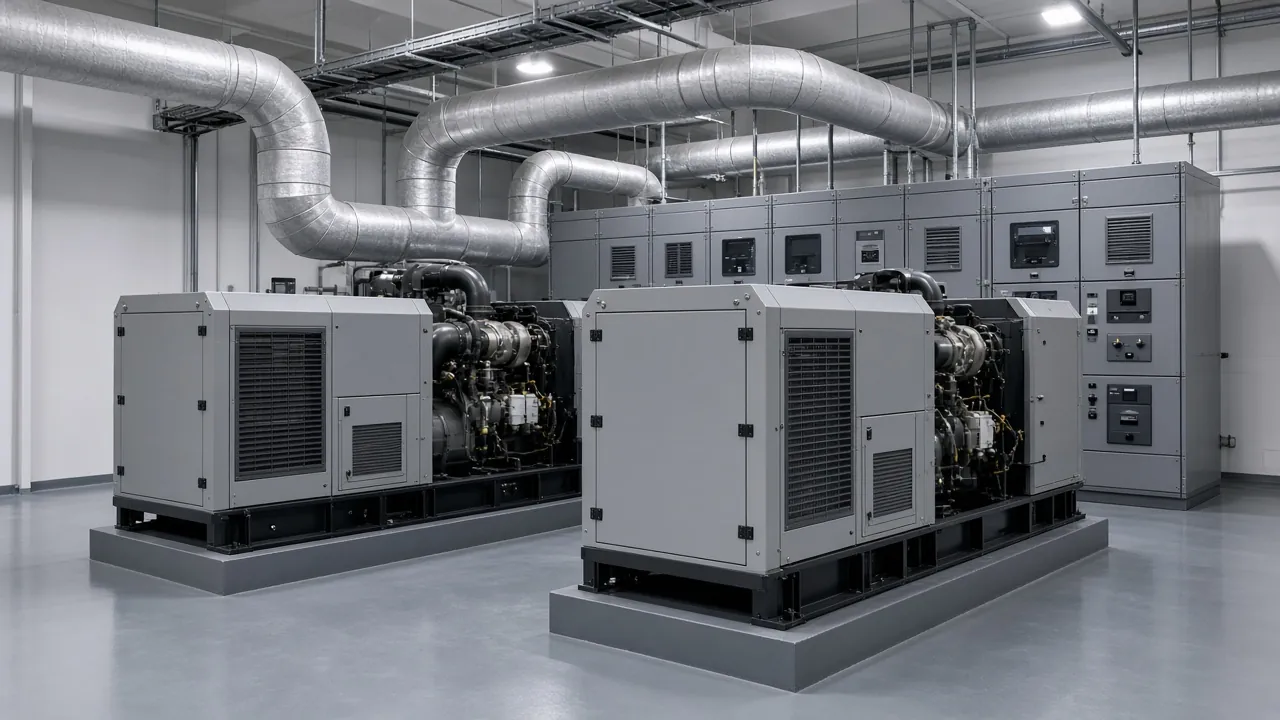
Engine exhaust contains carbon monoxide. Operators must not run portable generators indoors. You may install a fixed industrial generator in a dedicated generator room designed for the selected equipment. The room needs suitable ventilation, exhaust discharge and fire protection under applicable local requirements.
For room layout and canopy options, see our guide on enclosures and airflow.
Testing and records
Hospitals keep strict logs and run monthly testing under load. They also run regular load-bank tests as their site plan and code require.
Staff keep a written log of each test run, fluid check and alarm check. These records show readiness to inspectors. Factory tests before shipping also matter, as our quality assurance page shows.
What to ask the supplier
When writing bids for generators for hospitals, ask the supplier for full engine and alternator datasheets at 60 Hz. Confirm standby and prime ratings at the declared power factor. Also request step-load data, parallel controls and factory test reports. Clear data helps your engineer fit healthcare generators into custom industrial power solutions.