


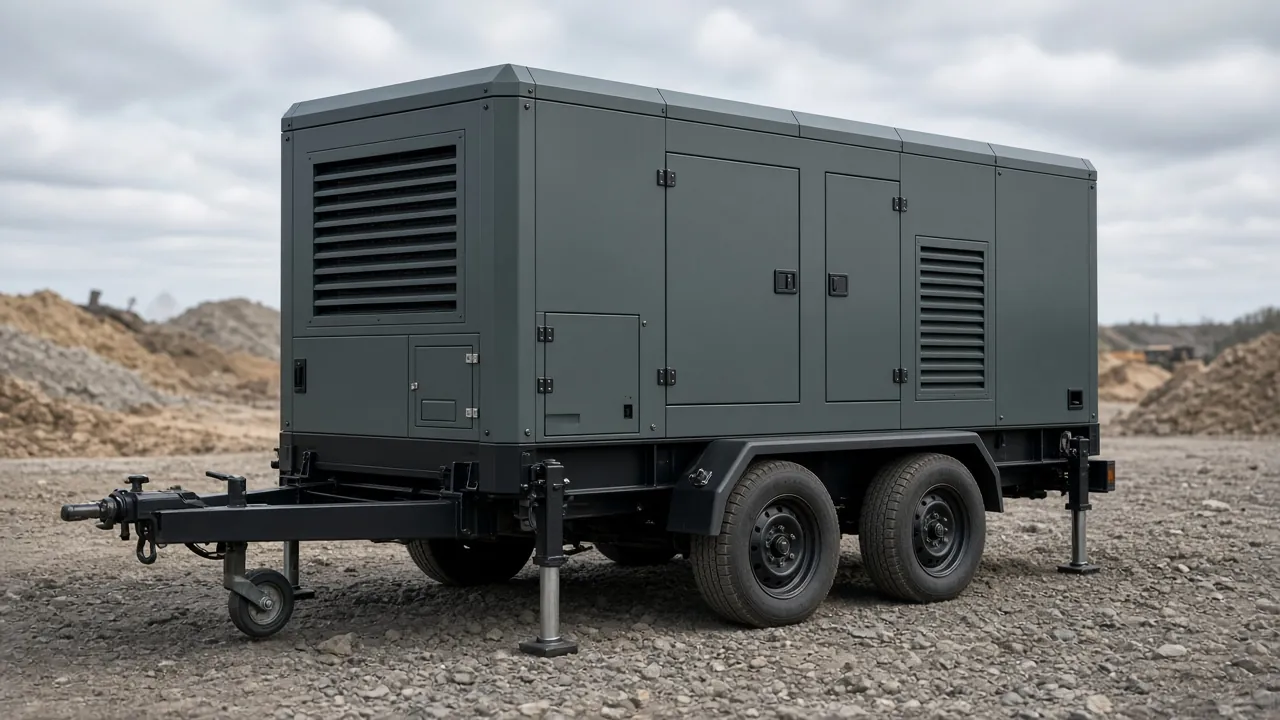



What a trailer mounted generator is and where it is used
A trailer mounted generator combines an industrial power unit with a wheeled chassis for regulated transport between locations. To pick the right genset (generator set), first identify its operating location and the electrical loads it will support. Contractors and utility personnel deploy these mobile power solutions across job sites, public events, and remote pump stations.
A towable unit also serves as a temporary backup power source during planned service or sudden power outages. For instance, data centers and hospitals often bring in a mobile backup generator while upgrading main switchgear. Because one trailer generator may support several buildings over the long term, its voltage setup must match each panel.
Size range first: generator sizing from the load list
Good generator sizing starts with a complete list of all equipment that will run at the same time. The real power formula is kW = kVA × PF. Use PF = 0.8 only where it is the declared equipment rating or an explicit calculation assumption.
Use the load’s actual power factor and starting characteristics for the load study. The three phase current formula is I = kW × 1000 / (1.73 × V × PF). The single phase formula is I = kW × 1000 / (V × PF).
Determine whether your site requires 60 Hz single phase 120/240 V service. Other sites need three phase 208 V or 480 V power outputs instead. Ask the supplier to verify motor starting currents for pumps and compressors before you select a model.
SEER POWER manufactures generator sets from 30 to over 1875 kVA. The 30–125 kVA diesel series comes in open, canopy and trailer mounted builds. The series covers about 24 to 100 kW prime power.
The SP-30WC gives 30 kW prime (37.5 kVA) and 33 kW standby (41.3 kVA). It pairs a Weichai WP2.3D40E200 engine with a Leroy-Somer or SEER POWER alternator. SEER POWER configures voltage options from 220 to 480 V for each project. For larger facilities, consider the 125–375 kVA diesel series.
Trailer data to specify
When ordering a trailer-mounted generator, request the mechanical drawing and weight sheet for that exact model. Axle ratings, gross weight, tongue weight, and hitch height must always come from the selected model datasheet. Matching the pintle ring or ball coupler to your fleet trucks prevents transport delays.
Will your crew tow generator trailers on public highways? Then specify lighting, wiring and brakes that satisfy local road regulations. Heavy duty tie-downs, leveling jacks, and wheel chocks keep a trailer with generator stable on uneven ground. Lifting eyes on the frame also help when a crane must place the unit.
Fuel tanks, fuel type and fuel supply
Selecting the right fuel type depends on how your crew will refuel the unit at each site. Most mobile units rely on diesel engines with built-in sub-base fuel tanks for independent field work. Your run time on diesel fuel depends on the tank volume on the datasheet and the applied load level.
Operating near the planned load maintains steady fuel efficiency. It also helps prevent wet stacking, as our guide on high diesel fuel consumption explains.
Does your facility have a reliable natural gas line, or room for LPG storage tanks? Then a gas powered generator can be a good alternative. For natural gas or LPG power projects, contact SEER POWER. Share your load, voltage, operating duty and fuel-supply details to discuss the configuration.
Enclosure, cooling system and safety features
A mobile industrial generator operates outdoors in rain, dust and heat. Therefore, most towable units use an acoustic weather canopy. The enclosure protects internal parts while keeping clear intake and exhaust paths for the radiator cooling system. You can review canopy layout details in our guide on enclosures and airflow.
Ask the supplier which safety features the unit includes. Typical examples are lockable doors and external emergency stop buttons. Others include main breakers and a grounding lug.
Engine exhaust contains carbon monoxide. Operators must not run a trailer generator indoors or in an enclosed space. Qualified staff must place the unit outdoors with exhaust aimed away from buildings, vents, and workers per local codes.
What to ask the supplier
Before buying, ask the supplier for the full generator set datasheet showing prime and standby ratings at 60 Hz. Confirm the voltage reconnection method, the declared power factor, controller features, and breaker sizing for your cables. Review trailer weights, axle and brake data, and service access under our service commitment and diesel generator troubleshooting guide.