





Applications & Project Planning

Commercial Backup Power Generators: A Business Guide

This guide explains how US businesses plan commercial backup power generators for reliable business continuity. You will learn how to estimate outage costs, prioritize critical loads, compare buying versus renting, and evaluate fuel and permitting needs.

3 min read By SEER POWER
On this page
  1. 1. Why commercial backup power is a business decision
  2. 2. Estimate what downtime costs your business
  3. 3. Which loads to back up: critical vs optional
  4. 4. A load calculation example
  5. 5. Buy or rent a backup commercial generator
  6. 6. Natural gas or diesel: choosing the fuel type
  7. 7. NEC 702, transfer switch and installation

Guide snapshot

Direct answer

Selecting a commercial backup generator starts with calculating hourly downtime losses and separating essential facility loads from non-essential equipment. Your electrical engineer then sizes the genset (generator set) for 60 Hz service, matches fuel supply, and designs a code-compliant transfer system.

This guide covers

  • How to estimate hourly outage costs and group facility loads into critical and optional tiers.
  • A sample three-phase load calculation and a practical comparison of buying versus renting standby equipment.
  • How natural gas and diesel options, local permits, and NEC Article 702 shape your commercial installation.

Best for

  • Facility managers, business owners, and B2B buyers planning continuity for offices, warehouses, retail stores, and plants.
  • Electrical contractors and consulting engineers specifying commercial standby power systems in the United States.

Why commercial backup power is a business decision

Commercial backup power generators protect a company from lost sales, stopped work, and spoiled stock during power outages. A properly sized backup generator for business keeps lights, servers, coolers, and production lines running when the grid fails. For data centers, retail operations, and small businesses, dependable electricity protects revenue and cash flow.

Hospitals follow strict NFPA 99 and NFPA 110 rules. For standard commercial buildings, planning focuses on cost, property, and staff safety.

Estimate what downtime costs your business

Before you request quotes, work out what one hour without power costs your firm. This estimate should include lost sales, idle labor costs and late delivery penalties. Also add the value of stock that spoils when cooling or heating stops. Compare this hourly loss with the cost of backup generators for business to see the payback time.

Which loads to back up: critical vs optional

Backing up a whole building needs a much larger generator set than backing up key circuits only. Facility managers split critical loads from comfort loads before sizing emergency generators commercial sites need. Critical loads often include exit lights, IT racks, checkout terminals, alarms, and cooling for sensitive stock.

A load calculation example

Alternators carry kVA ratings, while working load uses kW. At an assumed 0.8 power factor, 120 kW of running load needs about 150 kVA before margin. At 480 volts three-phase and 60 Hz, the same load draws about 181 amps. Our industrial three-phase generator selection guide covers these phase, voltage, and current checks.

Buy or rent a backup commercial generator

Whether to buy or rent a backup commercial generator depends on outage frequency and recovery time. Rental trailer units suit planned shutdowns, seasonal peaks, and short projects. During regional storms, however, rental fleets often run out of available units. Shipping delays then hold up delivery.

Owned standby generators commercial buildings rely on start within seconds through an automatic transfer switch. SEER POWER builds industrial diesel sets from the 30–125 kVA range to the 1875+ kVA range. Smaller offices often choose the 30–125 kVA diesel generator series. Larger sites look at the 125–375 kVA industrial series.

Natural gas or diesel: choosing the fuel type

A diesel generator keeps diesel fuel in on-site fuel tanks and does not rely on gas lines. In the 30–125 kVA range, the SP-30WC genset uses a Weichai WP2.3D40E200 engine. This set delivers 30 kW prime / 37.5 kVA and 33 kW standby / 41.3 kVA.

Natural gas and LPG units skip diesel refills where a steady gas main or bulk tank exists. For natural gas or LPG power projects, contact SEER POWER. Share your load, voltage, operating duty and fuel-supply details to discuss the configuration.

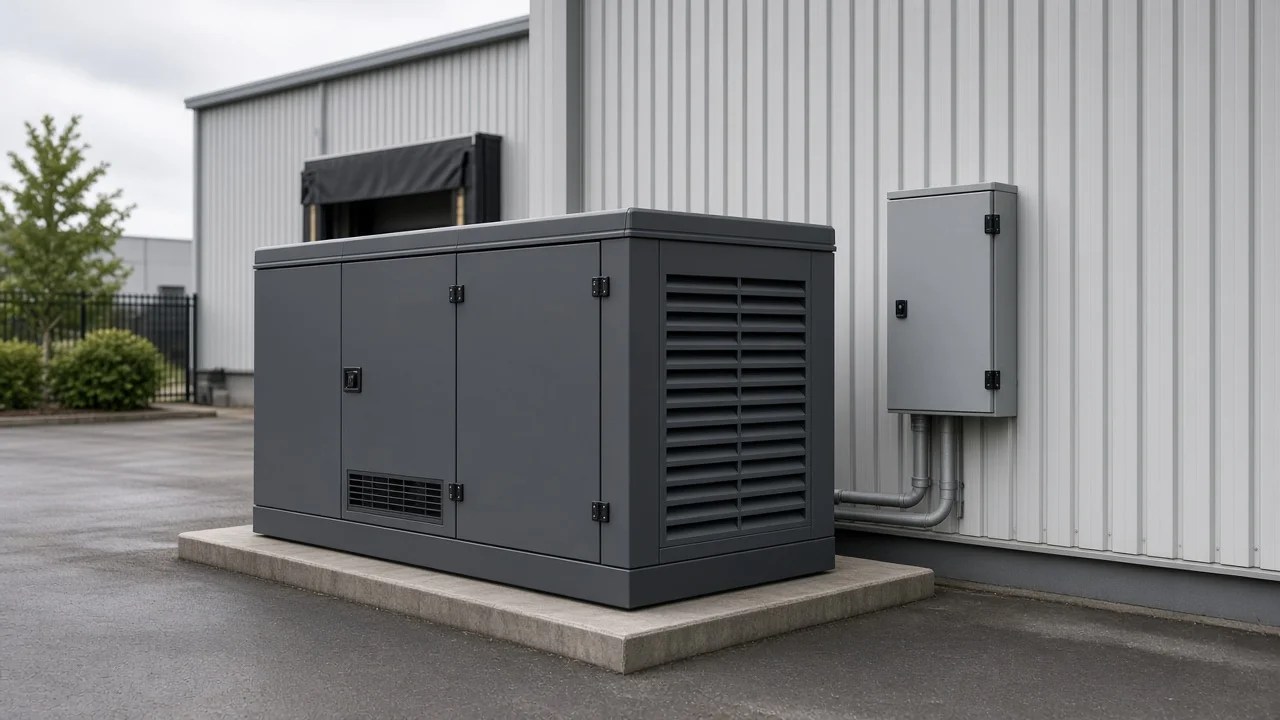
Local agencies may need air and fuel permits. Our industrial generator enclosures guide helps with outdoor placement.

NEC 702, transfer switch and installation

In the United States, commercial backup generator systems for optional business standby fall under NEC Article 702. These systems apply where life safety does not depend on generator operation. Emergency and legally required standby loads fall under Article 700 or Article 701. Qualified design engineers and the local authority having jurisdiction determine load classification.

Your licensed engineer and the local authority apply these rules to the wiring, transfer gear, and grounding. Typical commercial services include 120/208 V or 277/480 V three-phase at 60 Hz.

Engine exhaust contains carbon monoxide, an odorless gas that can be fatal in enclosed spaces. Operators must not run portable generators indoors. You may install a fixed industrial generator in a dedicated generator room designed for the selected equipment. The room needs suitable ventilation, exhaust discharge and fire protection under applicable local requirements.

Final checklist

  • Calculate hourly downtime costs and separate critical continuity loads from optional building circuits.
  • Confirm your 60 Hz service voltage, such as 120/208 V or 277/480 V three-phase, with the utility and electrical engineer.
  • Compare on-site diesel storage against natural gas or LPG supply, along with local air, fuel, and building permits.
  • Have qualified professionals design the NEC Article 702 transfer system and outdoor placement for carbon monoxide safety.

Frequently Asked Questions

How should a business determine the right backup generator size?

An electrical engineer adds the running kW of the chosen circuits and the motor starting surge. The engineer then converts the total to kVA using the loads' actual power factor. Small commercial buildings often fit the 30–125 kVA range, while larger plants need higher series.

When does buying a standby generator make more sense than renting one?

Buying makes more sense when your business needs power back fast during unplanned grid failures. Renting stays practical for planned shutdowns and temporary job sites.

Which power source suits commercial buildings: natural gas or diesel?

Diesel engines store their own fuel on site and do not depend on utility gas pipelines. Natural gas units avoid diesel deliveries where pipeline supply is steady, while LPG needs on-site tank refills.

How does adding a backup generator protect a facility's electrical system and provide reliable power?

An automatic transfer switch isolates the facility from the utility grid. After the engine starts and reaches operating speed, the switch connects and powers selected circuits during extended outages. However, standard generators and transfer switches do not condition utility power or prevent brief switching delays. Only sensitive electronics that require continuous or conditioned voltage need dedicated surge protection and an uninterruptible power supply.

Can single phase power support commercial applications?

Single phase power serves smaller sites. Verify the actual equipment load first. A natural gas generator provides commercial standby power if fuel supply, pressure, and equipment ratings align. Buyers must check manufacturer operating ratings instead of relying on a heavy duty label.

How does long term planning bring peace of mind?

A generator supplies continuity power for key loads, though brief switching delays still occur. This preparation offers peace of mind for planning goals during outages. Routine inspections and maintenance support long term readiness without performance guarantees.

Sources and technical references