


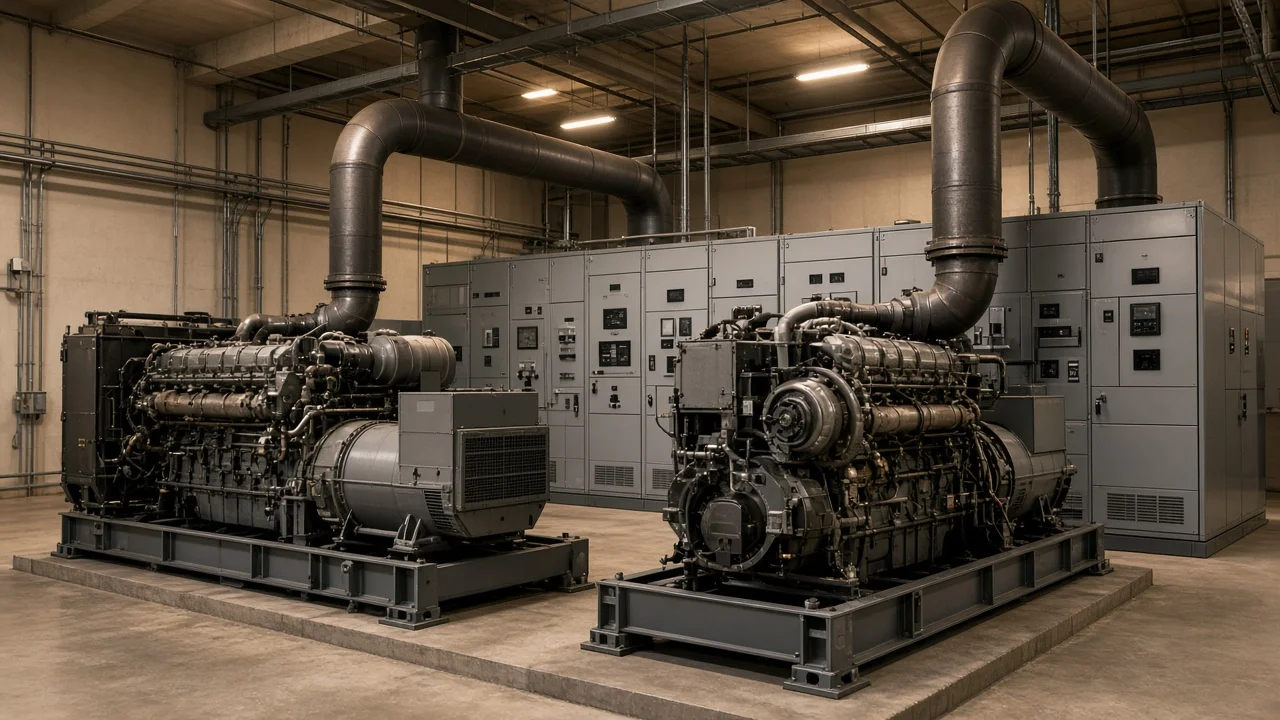



What sets an industrial emergency generator apart
An industrial emergency generator is a backup power generator for utility supply failures. Compared with other power sources, it offers autonomy and feeds production lines, centrifugal pumps, compressors and furnaces. Unlike office equipment, an industrial electric generator faces severe inductive loads and demanding ambient conditions.
Many buyers look for this equipment as an industrial light generator for their plant. Engineers call an industrial electric generator a generator set. Its internal combustion engine converts chemical energy into mechanical energy. The alternator, through its magnetic field, then turns that energy into electrical energy.
SEER POWER is a Chinese maker of industrial diesel sets from 30–125 kVA to over 1875 kVA. For natural gas or LPG power projects, contact SEER POWER. Share your load, voltage, operating duty and fuel-supply details to discuss the configuration. That way, buyers can evaluate the fuel type to suit the location.
Backup or continuous duty: standby vs prime in industry
The first technical step is to define the role of the generator. It may run only during grid outages or serve as the main daily source. The standby rating applies to sites with a stable power supply, where the unit runs only during occasional interruptions.
By contrast, prime duty is required when a mine, remote plant or pumping station has no power grid.
For mid-size plants, you can evaluate the 125 to 375 kVA diesel series against your load schedule. If the process needs more capacity, also review the 375 to 750 kVA industrial series in the catalog.
Process loads, large motors and starting
In an industrial plant, active power equals apparent power multiplied by the power factor. Use 0.8 only as a declared equipment rating or an explicit calculation assumption.
The electric motors of pumps, crushers, fans and compressors draw a high reactive current during starting. If all motors start at once, the current peak can cause a large voltage dip.
For this reason, the electrical engineer sets up a staggered starting sequence. The engineer also fits variable frequency drives or soft starters on the largest motors.
Voltage, 60 Hz and connection to the industrial switchboard
The Mexican power system operates at 60 Hz. This frequency sets the rated speed of the engine and the alternator. Industrial sites commonly use three-phase voltages such as 220/127 V or 440/254 V at distribution boards. Always confirm the voltage with CFE and with the electrical designer, who will size breakers, feeders and protections.
Several units in parallel and redundancy
In some processes, one interruption stops all production. There, several units in parallel are more flexible than a single unit. For example, two or three generators from the 750 to 1250 kVA diesel series can share the load of a heavy plant.
This arrangement allows N+1 redundancy, so one unit can receive maintenance while the others carry the critical process. To achieve this, each unit uses a parallel synchronizing module. It matches voltage, frequency and phase angle before closing the breaker.
Fuel, runtime and installation
Diesel is widely used in industrial plants because it allows on-site fuel storage in day tanks and main tanks. Some sites have a natural gas network or stationary LPG tanks. There, a gas unit can be another valid option.
During civil design, remember that engine exhaust contains carbon monoxide, an invisible poisonous gas. Operators must not run portable generators indoors.
You may install a fixed industrial generator in a dedicated generator room designed for the selected equipment. The room needs suitable ventilation, exhaust discharge and fire protection under applicable local requirements.
Also schedule mechanical care by following the manufacturer’s maintenance plan to extend engine service life.
What to ask the supplier
When requesting a technical offer, provide your load schedule with active power, power factor and the main motors. Specify the 60 Hz frequency and the exact switchboard voltage. Also state whether the unit will run on prime or standby duty.
Ask the manufacturer for the datasheet. It should list the engine model, alternator, enclosure type and control system scope.