


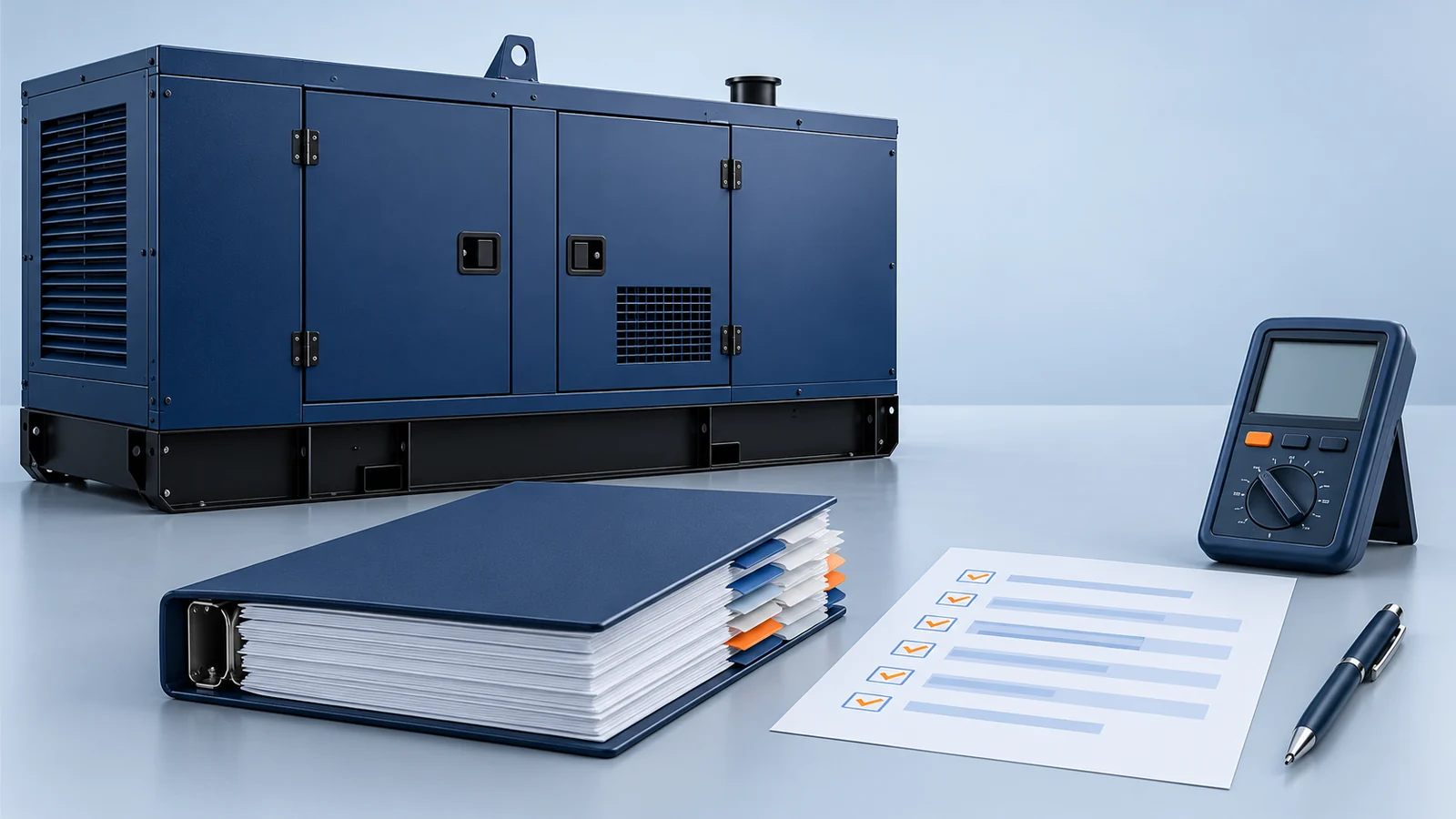



Define What Is Being Accepted
Generator commissioning handover documents must relate to the actual project. A commercial name does not define the included components or agreed tests. This guide proposes a way to organize industrial and commercial project records. It is not a national legal checklist or an energizing procedure.
When receiving an industrial generator, distinguish physical delivery from technical acceptance. Unloading the equipment does not prove that the electrical system is ready. An engine start does not demonstrate that the package can accept the required load during power outages.
Identify the generation function and the energy source being replaced or supplemented. The project must state which loads receive backup power and which remain outside that scope. Operational continuity depends on the complete system, its limits and each load’s demands.
A supplier may offer temporary and permanent power solutions. Retain the proposal with its contractual supply exclusions. It should identify the solution being delivered, its integrator and the agreed evidence.
Register Equipment and Documents
Prepare an equipment record with the model, serial number and specification revision of the industrial generator set. List the engine, alternator, controller and included accessories. Record the document supporting any component change.
The internal combustion engine provides mechanical energy to the alternator to generate electricity. The EIA guide to electricity generation describes this conversion. In the record, distinguish the complete set from the electrical generator within it.
The Cummins manuals portal supports engine manual searches by serial number. A commercial family name is insufficient to select the manual. Obtain documents for the delivered equipment and each manufacturer involved.
Create a document index with file name, revision, date and applicable equipment. Identify who performed each technical review and where the current copy is held. An older file supports comparison of previous versions. Keep it distinct from the version approved for the specific work.
Connect the Records with the Site
Collect approved drawings and accepted changes made during assembly. The document record should compare the proposal with the installed system. Identify differences that still need a response from the design authority.
For a project in Ecuador, record the site and the design ambient conditions. Do not copy another country’s voltages, permits or criteria without checking their applicability. The project team must confirm the site’s technical requirements with the responsible parties.
Record the relationship between the plant and the utility grid. If the design includes utility transfer, obtain technical documents for the equipment performing that function. A controller’s presence does not demonstrate that the supply transfers between sources as designed.
The cooling system, exhaust circuit and fuel supply also belong to the review scope. These records organize evidence. Qualified staff perform physical checks under the manuals and site safety plan.
Agree the Tests and Their Limits
Before testing, define the objective, included equipment and approved technical acceptance criteria. Distinguish catalogue capacity from the expected site response. Define how a result outside the criteria will be recorded.
The Cummins T-016 manual distinguishes prototype, factory and site tests. Within its paralleling-system scope, it also covers project-specific documents and commissioning reports. It is a reference for that system. It does not impose a universal sequence on every plant in Ecuador.
The test sheet should identify the drawing and method used, measuring instruments, units and initial conditions. Limits, load, duration and sequence come from the approved plan. They cannot be inferred from the plant name or an equipment photograph.
Where control systems are included, describe which functions will be tested and which require other work. Starting, transfer and load-response tests need separate results. A general “works” checkbox makes later fault assessment difficult.
Record What Happened
Assign each test a document reference with its date, equipment and responsible technical staff. Record actual values and the technical criteria used to evaluate them. Each conclusion should be traceable to that evidence.
When measuring fuel consumption, record the load and test conditions. Without those conditions, a reading does not support comparison of supply performance between tests. It must not become a fuel-saving or runtime promise for untested conditions.
Keep alarm, shutdown and repeated-test records needed to understand the result. If a test follows a correction, link both records. The new result must not conceal the reason for the first failure.
For its described system, T-016’s reporting section includes test data, control settings and review by the owner’s delegate. The project must agree the evidence and signatures for its own handover. Do not copy a statement of conformity from another set.
Close Outstanding Items and Assign Tasks
Maintain an outstanding-items list with the description, affected equipment, owner and expected response. Distinguish missing documents from technical defects. Decisions to accept, limit or repeat a test belong to those with project authority.
When a fault occurs, retain its history for generator problem assessment. This article does not authorize deleting alarms or bypassing protection to complete a handover record.
The handover should identify support contacts and operator limits, together with training delivered, topics covered and documents provided. Attendance at a training session does not by itself demonstrate competence for electrical work or internal adjustments.
Transfer recurring tasks to the standby preventive service plan. Retain the observed initial condition and agreed dates. Commissioning records do not replace future service records.
Preserve the Safety Scope
Engine exhaust contains carbon monoxide. Operators must not run portable generators indoors. You may install a fixed industrial generator in a dedicated generator room designed for the selected equipment. The room needs suitable ventilation, exhaust discharge and fire protection under applicable local requirements.
Tests must follow the approved hazardous-energy control plan. Do not use this guide for connections, switching or protection settings. A signed report does not authorize tasks outside the staff’s training or permissions.
At handover, retain use restrictions and unresolved defects. The final record describes the scope and conditions reviewed. It does not guarantee that failures will never occur.